
If you click on each image, you will be taken to a separate page containing an enlarged view of the entire print, as well as scans of the Artist's seals, etc. There will also be a link to an even larger image of the print. If you would like an even larger scan (at 600DPI), please feel free to email me here.
I have had to scan some of the larger prints twice and join them with image editing software. I have tried to hide the join as best I could but there may still be some discontinuity present (around the centre of the image).
The results of the evaluation are as follows:
All prints are real woodblock prints, but most from recut blocks
1) Kameido: posthumous print, Doi Eiichi, Harada, Seki, made in the
80s/early 90s
Many posthumous prints without seals are of low quality and found a shady way to the market without approval of the publisher.
2) Miyajima: no seals, circa 1960s to 1990s
3) Matsushima: Doi Eiichi, Endoh, Itoh, posthumous, around 80s
4) Kiyomizudo: rare seal "Hanmoto Tokyodo", who distributed prints for Doi, post-war
5) Akashi Harbour, Doi Eiichi, Harada, Seki, posthumous, see 1)
6) Yakitsugahara: no seals, circa 1960s to 1990s, very recent strike, bad
registration = worn blocks
7) Maiko Beach: circa 1960s to 1990s
8) Miyajima Rain: no seals, circa 1960s to 1990s
Let's take one more look at the results of this evaluation.
Firstly, all of these prints were originally published by the Doi publishing house. This is not surprising, because although Koitsu worked with several publishers during his lifetime (including Watanabe, Baba Nobuhiko, and Takemura, among others), the vast majority of prints were done via his association with Doi Sadaichi, founder of the Doi publishing house.
As can be seen in the first image (Kameido Shrine), the Doi publisher, printer and carver seals are usually placed in the lower area of the left margin. The publisher seal is the upper seal, while the printer and carver seals are grouped as two seals with a slight vertically offset.
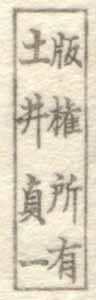

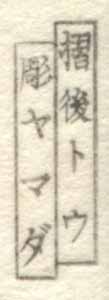
So, why do so many prints have the publisher, printer, and carver seals missing? This is a very good question, and one that cannot currently be answered with complete certainty. It is speculated that these prints found their way to the market around the 70's and 80's (an estimate based on paper characteristics) without the knowledge of the Doi publishing house, and as such should be considered 'dubious', and thus worth less than a print of the same vintage that contains the official seals. Another explanation from a reliable source is that the recent Doi printers were allowed to print a number of copies of a print for private sale, perhaps as a part payment for their services. Indeed, in the late 90's the source of this information in fact purchased prints without seals directly from a former Doi printer! Thus this explanation seems, to me at least, credible. Whichever is the case, it would appear that prints without seals are quite recent strikes, and it would therefore be wise to consider this point when determining their monetary value. Update 2010: you can read our Koitsu Raisonne for further details, be we can conclude that Koitsu and Hasui prints that do not contain publisher seals did not reach the market with the blessing of Doi (to put it politely).
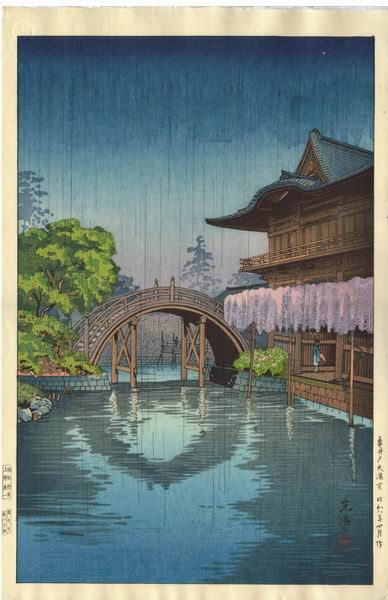 Kameido Shrine, by Tsuchiya Koitsu (1933)
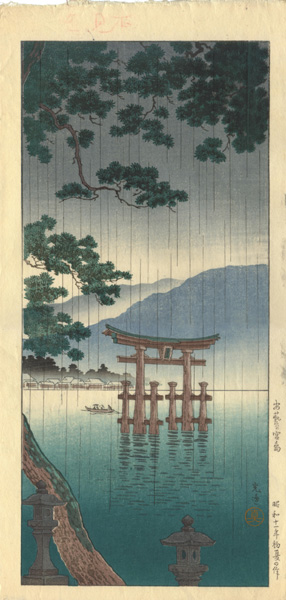 Miyajima In Aki, by Tsuchiya Koitsu (1936)
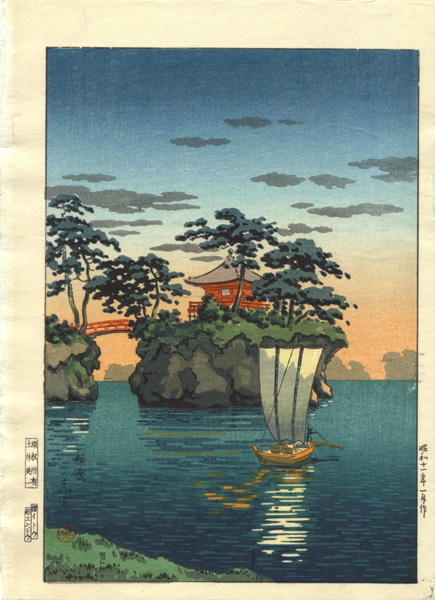 Matsushima, by Tsuchiya Koitsu (1936)
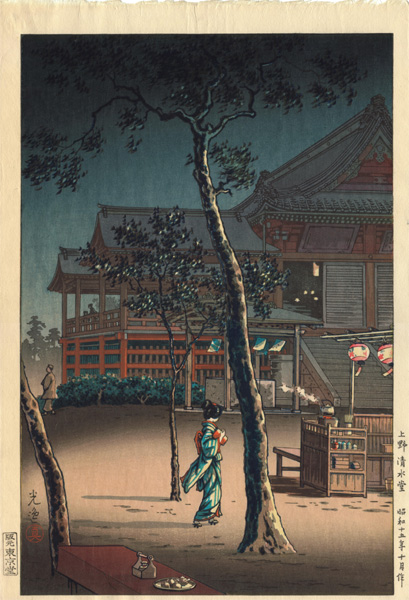 Kiyomizudo In Ueno, by Tsuchiya Koitsu (1940)
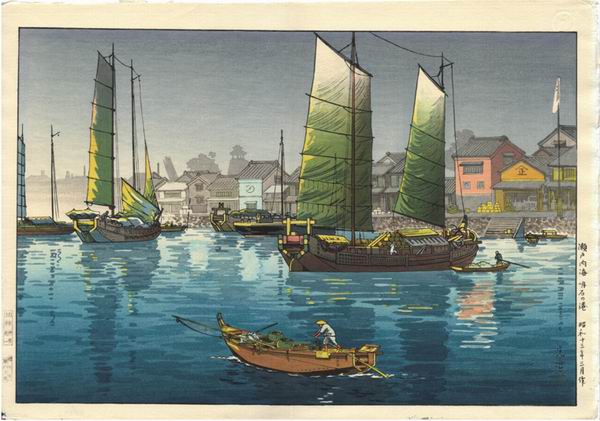 Akashi Harbour, by Tsuchiya Koitsu (1938)
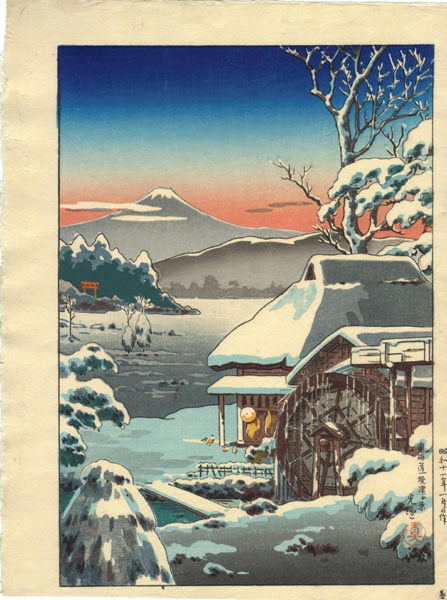 Yakitsugahara, by Tsuchiya Koitsu (1936)
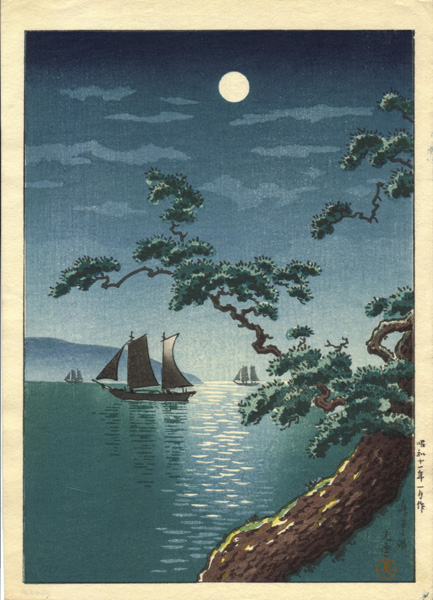 Maiko Sea Shore, by Tsuchiya Koitsu (1936)
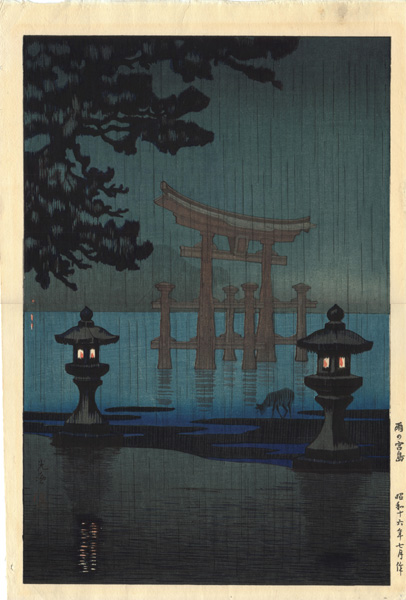 Miyajima In The Rain, by Tsuchiya Koitsu (1941)
| Back to Research & Articles | Back to Koitsu.com Home | Back to Ohmi Gallery Home |