
Please also read this 2019 update
Our initial attribution of Koitsu prints containing the Onotomi seal as being post-war strikes by the publisher Kyoto Hanga-In was based on the following evidence:
Based on (2) above, the connection between the printer Onotomi and Kyoto Hanga-In is irrefutable. At some time in the 1950s, Ono Tomisaburo certainly printed Ohno Bakufu scenes for Kyoto Hanga-In. However, the statistical evidence suggests that Ono's relationship with Kyoto Hanga-In lasted only a very short time. I've just completed an analysis of over 600 Kyoto Hanga-In published prints and found that a total of only three prints contain the Onotomi printer seal. Just three. And those three prints represent only two scenes, so I believe he printed only a single, small edition of each of those two scenes. Interestingly, none of the three prints contain the usual set of Kyoto Hanga-In "Shinagawa-ban" seals that we find accompanying all other examples of those scenes. I conclude that Ono Tomisaburo's relationship with Kyoto Hanga-In was only fleeting. He clearly was not in the permanent employ of Kyoto Hanga-In (who already had several in-house printers), and therefore it is likely that Kyoto Hanga-In simply outsourced the printing of these two Bakufu scenes to Ono.
But if the Kyoto Hanga-In published Bakufu prints contain the same Onotomi seal as the Koitsu scenes, doesn't that mean that those Koitsu scenes must have been printed and published by Kyoto Hanga-In? Actually, no it doesn't. Woodblock print artists and printers often kept their own seals in their possession. For example, when my co-researcher and I visited Chigasaki Museam of Art to examine the data they held on Tsuchiya Koitsu, we were shown a box of seals that Koitsu had used throughout his career, and we were able to identify at least one as being the same seal that we had viewed on one of his published prints. Given the fact that Ono Tomisaburo worked for various publishers from the pre-war to the early post-war period, including Watanabe, Fusui Gabo, Takamizawa, Kondo Kihachiro, and Kyoto Hanga-In, it would appear to me that Ono likely kept his seals in his possession and used the same seal on Koitsu prints when he worked for Baba pre-war, and on Bakufu prints when he worked for Kyoto Hanga-In post-war.
Another point to keep in mind is that it is highly unlikely that any of Baba's woodblocks survived the fire-bombing and resulting extreme conflagration that occurred toward the end of WW2. My co-research Tosh Doi confirmed via Yokohama City Council that the street that housed Baba's printing workshop was completely destroyed by fire. It is possible that blocks for certain scenes were recarved, however we have not noted any prints showing signs of having been printed from recarved blocks. Perhaps the original blocks were stored for safe-keeping during the war and survived the conflagration? Yes this is also possible of course, but if this was the case we would expect to see a far larger number of Koitsu/Baba prints in circulation than we see now, considering the 1950s were boom years for shin-hanger publishers, and (I cannot stress this point enough) we would see some evidence of tourists having purchased Koitsu prints from Baba, as we see for all the other major publishers like Watanabe, Doi, and Kyoto Hanga-In. During 20 years of researching Koitsu and monitoring art dealer and auction websites I have not noted a single case of a purchaser of a Koitsu/Baba print that claimed the purchase was made post-war.
We have confirmed that Baba Nobuhiko reopened his business after the war and continued publishing from 1948 until at least 1956. It is important to note that none of these confirmed post-war editions contain the Onotomi printer seal, and given we have confirmed the Onotomi seal on a print housed in a Baba Seizando folder, and on various prints with Baba watermarked paper (found on most pre-war editions), I conclude that it is most likely (but not proven) that Baba-published prints that carry the Onotomi seal are pre-war editions, and furthermore it is likely (but not proven) that all Baba-published Koitsu prints (apart from perhaps a few poorly carved postcards) were published pre-war.
| First published | Printing Date (best estimate) | Artist | Title | Publisher | Link | Notes |
|---|---|---|---|---|---|---|
| 1948 | 1948 | Sekido, Isaburo | Kenkiji Temple | Kondo | link | Notes |
| 1939 | pre-war | Tsuchiya Koitsu | Yomei Gate | Baba Nobuhiko | link | Baba watermarked paper |
| 1939 | pre-war | Tsuchiya Koitsu | Sarusawa Pond | Baba Nobuhiko | link | |
| 1939 | 1939<->1950 | Tsuchiya Koitsu | Sacred Bridge | Baba Nobuhiko | link | No publisher seal, so it is possible that this print was printed at Kyoto Hanga-In. However, it is most likely that all of Baba's woodblocks were destroyed by fire due to allied bombing of Yokohama toward the end of the war, so we feel it is most likely to be stock that was passed on to KHI by Baba. |
| 1939 | pre-war | Tsuchiya Koitsu | Sacred Bridge | Baba Nobuhiko | link | Baba watermarked paper |
| 1939 | pre-war | Tsuchiya Koitsu | Atami | Baba Nobuhiko | link | Notes |
| 1938 | pre-war | Tsuchiya Koitsu | Banyu River | Baba Nobuhiko | link | Housed in it's original folder that contained the Baba Seizando publisher seal. Contains a different version of the Onotomi printer seal. Thus, almost certainly a pre-war strike. |
| 1930s | 1930s | Takahashi Shotei | Beauty Before the Mirror | Fusui Gabo | link | Onotomi seal at lower left |
| 1932 | 1932 | Kobayakawa Kiyoshi | The Mistress Okichi of Shimoda | Hasegawa | link |
| Publisher Seals | Dating | Publisher | Comment | |||||||||||||
K0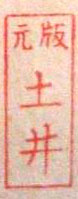 |
K1 |
K2 |
K3 |
K4 |
K5 |
K6 |
K7 |
K8 |
K9 |
K10 |
K11 |
K12 |
K13 |
Pre-war 1930s to early 1940s |
Doi Sadaichi publisher seals | |
K21.jpg) |
K22.jpg) |
K23.jpg) |
K24.jpg) |
K25.jpg) |
K26.jpg) |
Post-war 1948 to about 1950 |
Doi Hangaten in-line publisher seals | |||||||||
K31 |
K32 |
K33 |
K34 |
K35 |
K36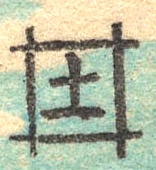 |
Post-war 1950 to 1963 (K35 = 1990s) (K36 = 1950s to present) |
Doi Hangaten offset publisher seals, with Harada as carver and either Yokoi, Ito, or Goto as printer. | |||||||||
K51 |
K52 |
K53 |
K54 |
Post-war 1963 to about 1981 |
Hamamatsu-Do | |||||||||||
K61 |
K62 |
K63-Se-Hd.jpg) |
K64 |
K65 |
Post-war 1981 to present |
Doi Eiichi publisher seals | ||||||||||
K41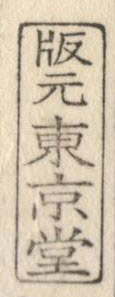 |
K71 |
K41 = early Post-war K71 = late 1930s |
K41 = Tokyo-Do K71 = Iida Kunitaro |
Tokyo-Do and Iida Kunitaro were not publishers but distributors of Doi-published prints. | ||||||||||||
| Publisher Seals | Dating | Publisher | Comment | |||||||||||||
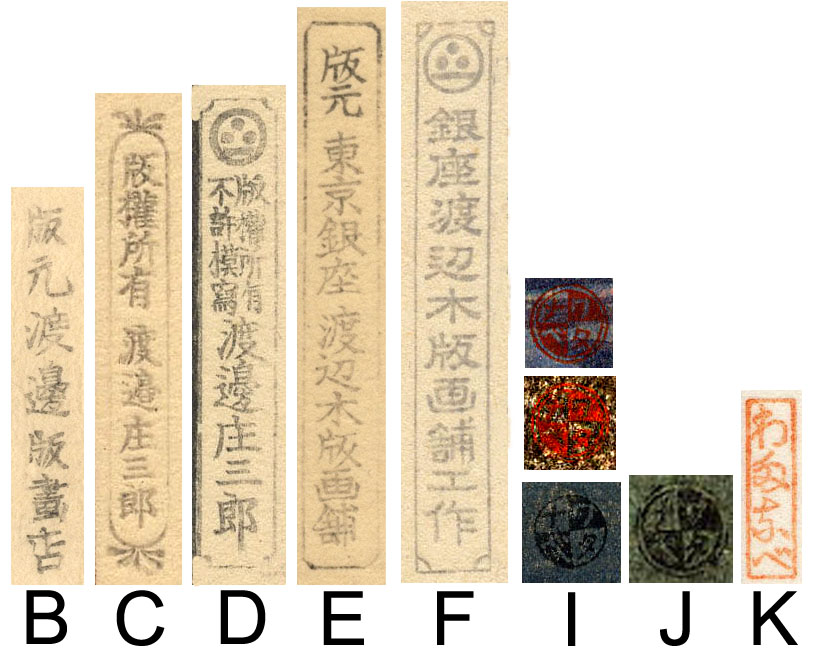 |
B to F = Pre-war I = 1946 to 1957 J = from 1957 K = from 1989 |
Watanabe Hangaten | Other Watanabe seals have not been found on Koitsu prints. | |||||||||||||
| Publisher Seals | Dating | Publisher | Comment | |||||||||||||
K100 |
K101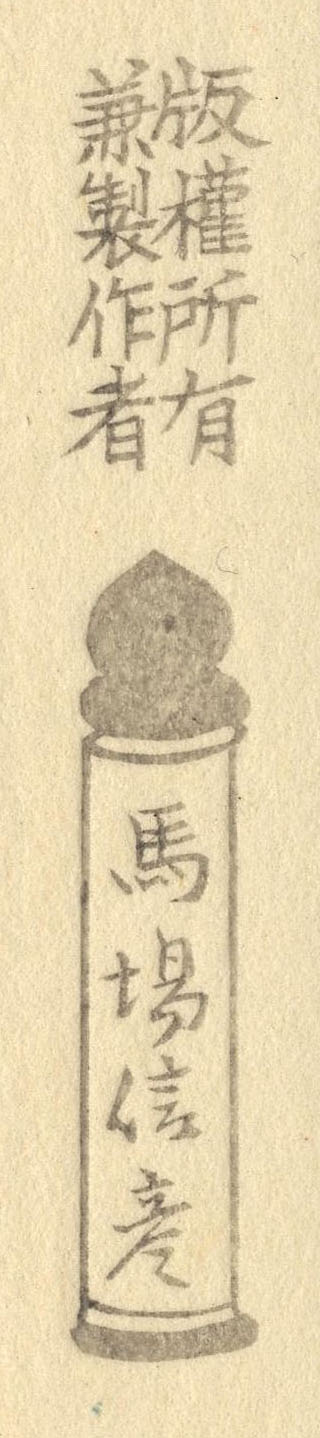 |
K102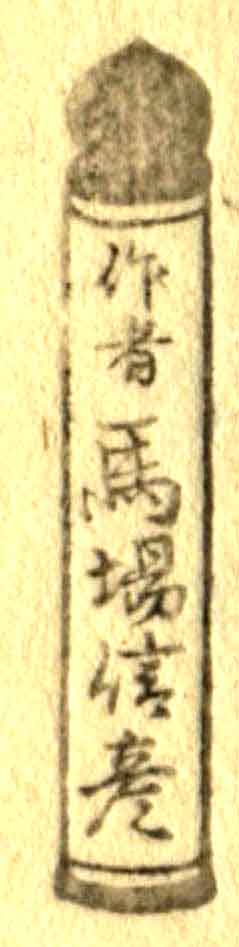 |
K103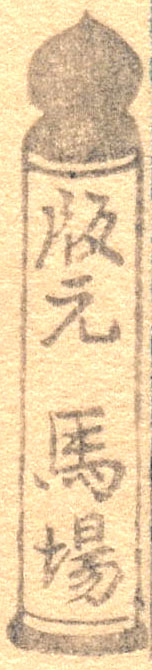 |
K104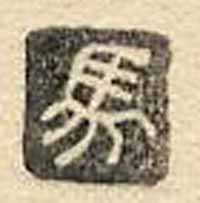 |
K105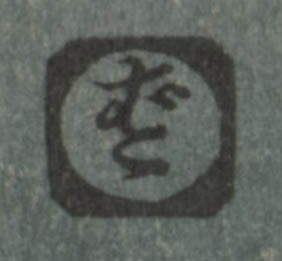 |
K106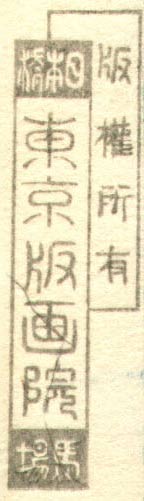 |
K107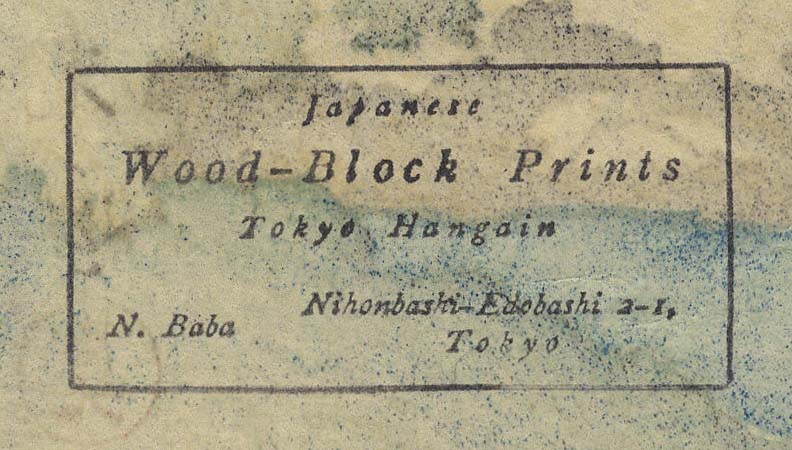 |
K108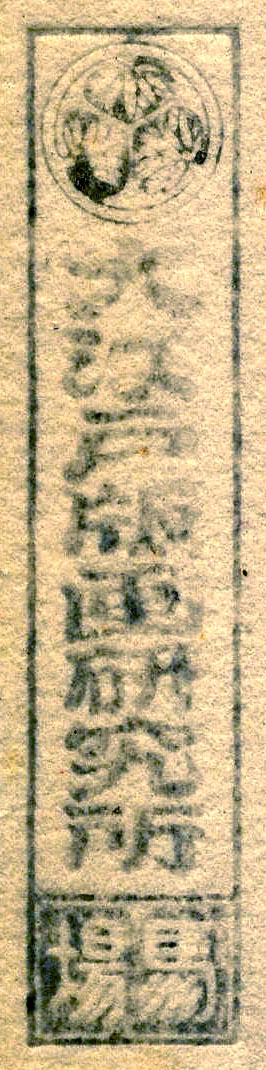 |
*1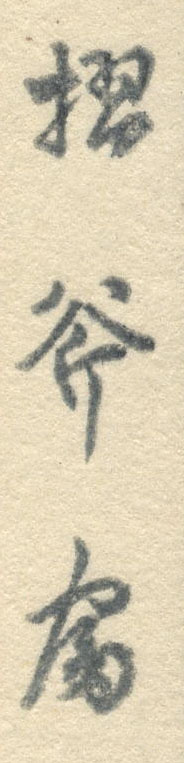 |
*2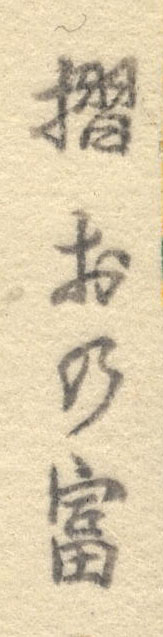 |
Pre-war 1930s to early 1940s *1, *2 = pre-war, possibly postwar strike |
Baba Nobuhiko (K100 to K105), Tokyo Hanga-In (K106, K107), Oedo Hanga Kenkyusho (K108) publisher seals | *1, *2 = printer Ono Tomisaburou's "Onotomi" seal, used pre-war and possibly early post-war. | |||
| Back to Research & Articles | Back to Koitsu.com Home | Contact | Back to Ohmi Gallery Home |